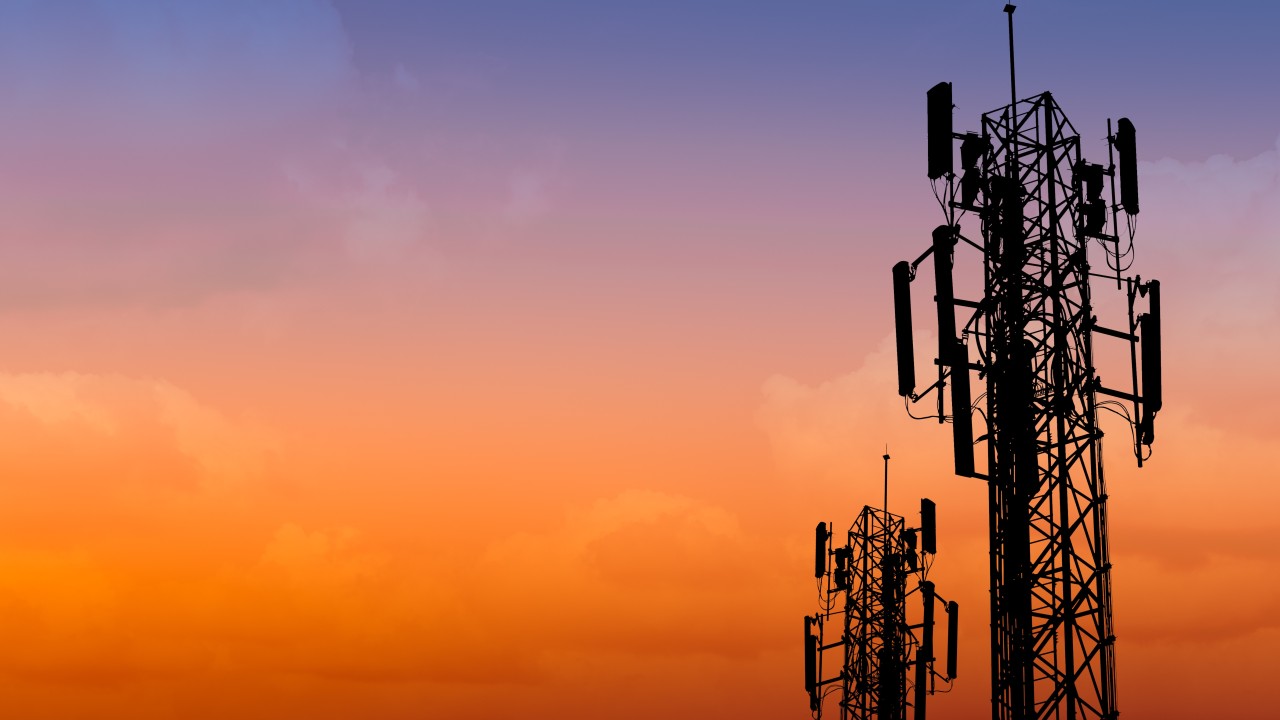
The cleanest fit is not about subscribers
Barclays this week called T-Mobile the "strategically cleanest" Big Three fit for a potential SpaceX acquisition, citing its lower rural share as a complement to Starlink's strength in rural areas. T-Mobile shares rose 4.1% on Monday, the best of the three carriers, and SpaceX stock gained about 6%. The reasoning is worth taking seriously, because it rests on something simpler than the stock chatter. Satellite and terrestrial networks are good at different jobs, and only one of them scales to a city.
One beam, a thin slice of capacity
A satellite beam covers an enormous area, and everyone under it shares a thin slice of capacity. That makes direct-to-cell superb for coverage, texting, IoT and dead zones, and a poor fit for a city's worth of traffic.
T-Satellite delivers roughly 4 Mbps in fair conditions, according to researchers cited by BGR. SpaceX says it is targeting 150 Mbps peak per user in the next generation, with testing aimed at late 2027 and about 15,000 more satellites. Even then that capacity is shared across a beam, while a city needs it in every block, indoors and on trains. Analysts at BNP Paribas make the same point in Fierce: satellite struggles indoors and in large cities, so it complements terrestrial networks rather than replacing them.
Building takes a decade. Buying takes a signature.
To compete with the carriers instead of complementing them, SpaceX needs a terrestrial layer: spectrum in the right bands, towers, backhaul and a retail machine of handsets, financing, billing and customer care. Barclays lists the same gaps, along with roaming and time.
SpaceX does have a start. It holds about 80 MHz of spectrum against T-Mobile's nearly 400 MHz, and it plans its own terrestrial 5G network on Qualcomm platforms, with deployment starting in 2027. Even so, I would put a national footprint, customer base and brand closer to a decade of work. Buying an operating network takes a signature.
What already points that way
SpaceX is already paying for spectrum like a carrier. It agreed to buy EchoStar's AWS-4 and H-block licenses for about $17 billion, up to $8.5 billion in cash and the rest in SpaceX stock, plus about $2 billion toward EchoStar's interest payments through November 2027, according to Fierce. That spectrum is aimed at satellite service, so it is not proof of a terrestrial plan, but it shows the appetite. A November 2025 amendment added EchoStar's unpaired AWS-3 licenses for about $2.6 billion in SpaceX stock, which lifts the spectrum total to roughly $19.6 billion. The Washington Post also reported on November 2 that SpaceX has held talks with EchoStar about buying Boost Mobile or gaining network access, after the three big carriers reportedly declined its network-access requests. Boost relies on other carriers' networks, so buying it would bring subscribers and retail more than towers, which is the same gap.
The relationship with T-Mobile is also in place. T-Satellite runs on Starlink and costs $10 a month or comes with T-Mobile's Experience Beyond plans, so an acquisition would be an escalation, not an introduction. Musk has also said that buying a legacy telco could help SpaceX use its spectrum more effectively, as reported after the Baron Investment Conference.
Two complications
First, this is a negotiation with Bonn as much as with Bellevue. Deutsche Telekom owned 54.2% of T-Mobile US at June 30, 2026 counting treasury shares (45.5% directly), and can vote 55.1% through a proxy agreement covering SoftBank's shares. In February it said it had no plans to sell T-Mobile US shares in 2026, and its CEO said the company keeps looking at ways to increase its stake.
Second, regulators would take a long look at the largest satellite constellation joining a top-three carrier. T-Mobile's CEO has also said he sees no room for an MVNO for satellite or SpaceX on T-Mobile's terrestrial network. Barclays frames this as a prisoner's dilemma: each carrier gains by selling SpaceX spare capacity, but all of them gain by denying it terrestrial access.
The prize is the ground segment
The prize is not T-Mobile's subscriber count. It is that a terrestrial network stops being a standalone business defending itself against satellite and becomes the ground segment of one integrated network, with satellite as the coverage layer and the towers as the capacity layer. That is a new purpose, and it revalues the assets on both sides of the deal.
It is also why the logic holds even if the stock chatter fades. Coverage without capacity is a niche, and capacity without coverage is a commodity.
What it means for the people who build networks
If the integrated network is the direction, the next decade of value sits in the seams. Fiber backhaul to every tower and small cell, power and permitting for new sites, and the cores and ground stations that tie two networks into one all have to be built, and quickly. Whoever buys what, the ground segment still has to be built on the ground.
I work at Congruex, where we build fiber, civil and power infrastructure for carriers and hyperscalers in more than 40 states, so I see this from the build side. Whatever happens with a deal, SpaceX's own terrestrial plans, or the network it ends up owning, mean a great deal of fiber to towers and sites. That demand exists whether SpaceX buys a network or builds one, and it goes to the builders who can deliver it at scale.
Where do you see the capacity layer coming from: the carriers, SpaceX, or both?